
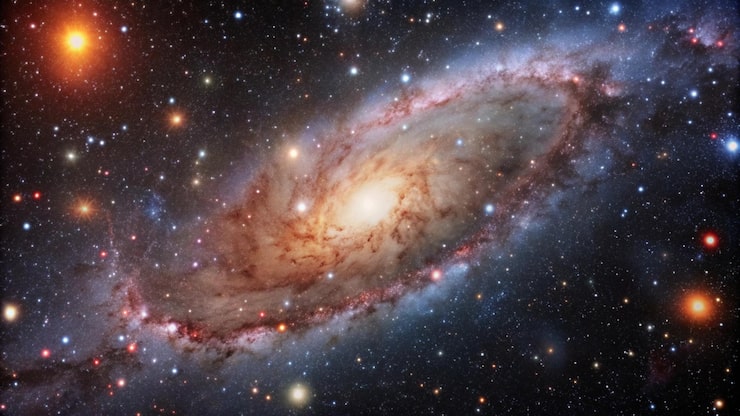
The universe packs around two trillion galaxies in the slice we can spot with telescopes today, a count pulled from deep Hubble and James Webb stares that catch faint far-off ones early scopes missed. That number sits for the observable chunk 93 billion light-years wide while talks swirl if space rolls endless or bubbles into multiverses with 10^10^16 others, each stuffed with its own galaxies.
NASA's work drives the tally, starting from old 100-200 billion guesses and climbing as tech peels back dust and distance. Flat shape hints at no end in sight, so galaxies likely stretch forever past our view, locked away by expansion that reds out their light.
What We Can See Right Now?
Picture the observable universe as a giant bubble around us, stretching 93 billion light-years wide. Light from its far edge took off right after everything began and only now hits our telescopes. Back when scopes first peered deep, they spotted 100 to 200 billion galaxies. But push further, and faint ones buried in the glow jump out, bumping that number way up.
I remember aiming a small backyard telescope at a blank sky patch once. At first, nothing but black. Then, after minutes, fuzzy shapes appeared whole galaxies packed into a spot smaller than my thumb. NASA's photos do the same on a grand scale. They aim at empty corners and pull back curtains on thousands of galaxies per shot, each packed with stars. The James Webb scope takes it deeper these days, locking in that two trillion count.
Take our Milky Way. It spins as a barred spiral, 100,000 light-years tip to tip, home to 100 to 400 billion stars. Andromeda looms next door, on a slow crash course with us billions of years from now. Then come the dwarfs small, dim hangers-on that orbit the big ones and swell the total count.
Read More: Latest discoveries in space exploration
NASA's Role in Pinning It Down
NASA drives these finds with tools like Hubble and its sharper successor, James Webb. Back in 2016, they crunched numbers from infrared shots and landed on two trillion. Those views catch galaxies too hidden for regular light, reaching back to 400 million years after the start.
They build trust by counting what's real in mapped sky sections, then multiply out. Hubble's deepest image squeezed a decade of stares into one frame the size of a pinprick, revealing over 10,000 galaxies. Scale that across the dome above, tweak for the ones that slipped by, and two trillion fits.
Dust clouds block some, distance dims others, and space itself stretches light thin. Fresh James Webb data through 2025 and into now keeps tweaking things, but two trillion stands firm.
Does It All Keep Going?
Ever wonder if space hits a wall or rolls on without end? Clues lean toward endless. That ancient Big Bang glow maps out flat geometry on huge scales. Flat means no bend back on itself, like driving straight across an endless plain.
Things pull apart everywhere, quicker for stuff farther off, driven by dark energy. Rewind it all, and no edge shows just growth from a hot start. Infinite space would pack endless galaxies in bubbles we never touch.
Others picture a loop, like walking Earth's curve until you circle home. Checks find no loop yet. Our view spans 93 billion light-years, but the whole setup dwarfs it or runs forever. Two trillion fills what we hold.
Thoughts on More Than One Universe
Our setup might sit as one bubble among many. Folks talk multiverse, where pockets run by different rules maybe no stars, or gravity that crushes everything. Inflation right after the Bang sparked bubbles from tiny wiggles.
Andrei Linde and others ran the math. Quantum ups and downs could birth 10^10^16 setups a stack so tall it breaks normal counting. Caps from tests hold it there, but real tallies might tower higher.
String ideas and quantum rules nudge this way. Imagine our patch as one bubble floating in a foam of others, each brewing galaxies. True or not, it blows galaxy counts past two trillion.

The Work of Tallies
Surveys blanket the sky first. Sloan projects log millions of dots. Scopes split galaxies from stars—fuzzy blobs versus pinpoints.
Deep shots fill gaps. Hubble's extreme field stacked years into 5,500 galaxies. James Webb cuts through dust in infrared, grabbing early builders. Machines flag shapes, people double-check.
Red stretch from pull-apart dims far ones. Some hide or smash together. Tech fights back, lifting counts.
Shapes and Stories
Spirals whirl with fresh star nurseries in arms. Ellipticals glow red and calm, leftovers from crashes.
Irregulars twist from old hits, like our nearby Clouds. Dwarfs pack dark stuff, outnumber all. Hubble classed them; new eyes spot mixes. Young mess built to giants over time. All types tally to two trillion.
You May Also Read: Space Technology Used in Satellite Development
Past the Edge We Know
Light sets our limit beyond, it never arrives. More galaxies likely churn there, same dance of build and spread. Dark energy hides them over eons. James Webb caught big early ones that grew too quick for old tales. Roman scope ahead will chart billions fresh.
Closing Thoughts
Grab a moment under open sky when stars shine clear. Our view catches two trillion galaxies across the stretch we call observable universe.
Teams stacked decades of scope time to build that tally, each upgrade spotting farther specks lost before. Space might roll out endless or pack side pockets of whole other setups it shakes you and keeps experts glued to their hunt.
Let those stars pull you next time, each galaxy humming with billions of lights and paths we only guess at. Eyes up keeps you ready for the next big reveal sitting right on the edge.
FAQs
How many galaxies are in the universe, per NASA findings?
NASA pins it at roughly two trillion after Hubble and James Webb pulled in shots of dim, far-flung galaxies most scopes miss.
Does the universe run infinite, packed with galaxies forever?
Data on its flat layout points that way endless stretch beyond our view could mean galaxies never quit.
How many universes exist out past ours?
Multiverse ideas run wild with numbers like 10^10^16 others, every one a potential galaxy factory on its own.
What stops a full count of galaxies in the universe?
Space expansion drags light from the farthest ones into red haze, too weak for any telescope to grab hold.
Did galaxy counts in the universe shift through the years?
Counts started low at 100-200 billion from first deep looks, but sharper scans settled on two trillion firm